
 English
 Turkish
 03 MAYIS 2026


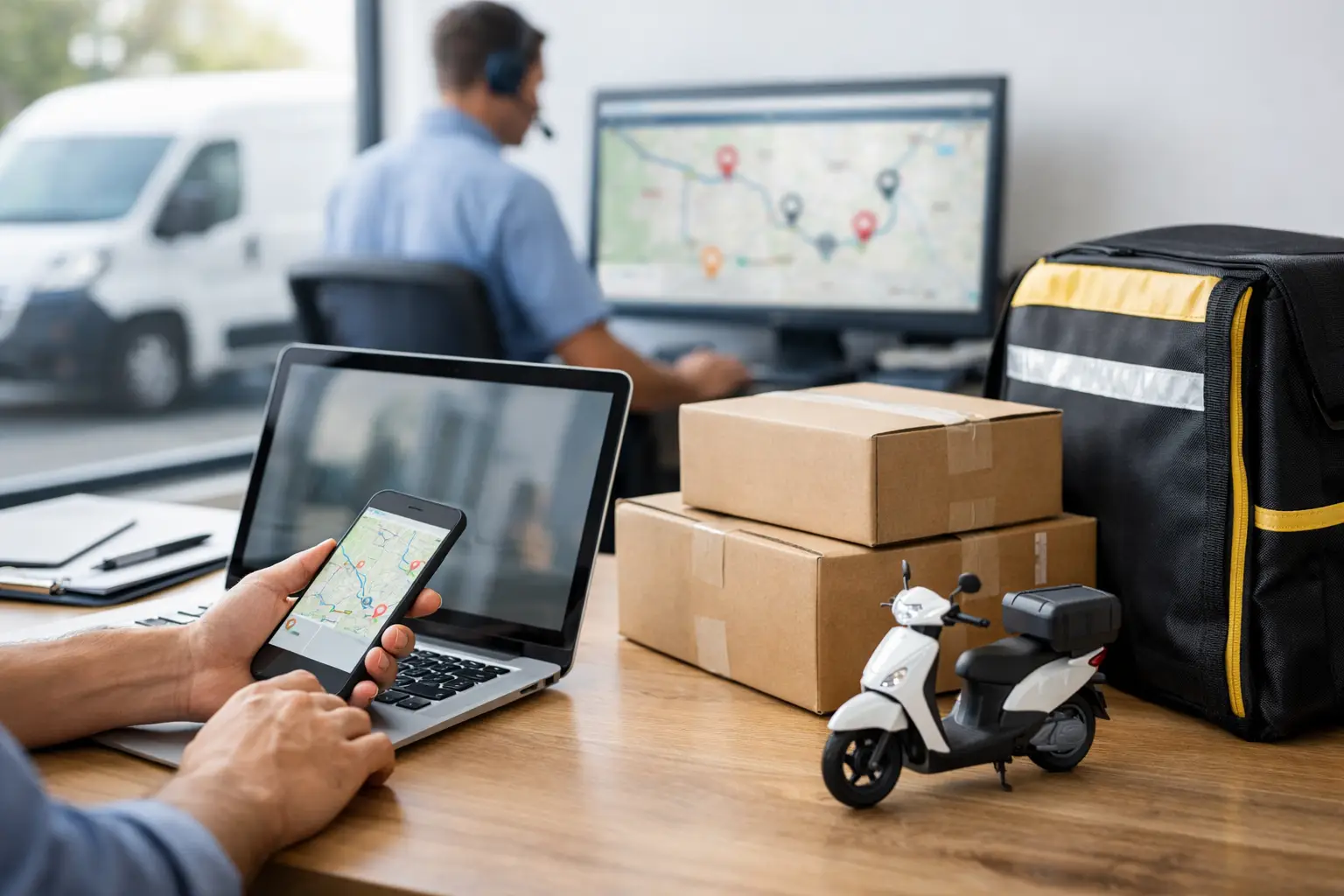
On the operations desk, problems often appear before the software: delayed deliveries increase, drivers call each other in the field, and the customer support team tries to answer the question "Where is the courier?" dozens of times simultaneously. At this point, a courier management system purchasing guide should be considered not just a software selection, but a process of re-establishing operational control. The right system increases delivery speed; the wrong one transfers the existing chaos to the digital realm.
Many businesses begin their purchasing decision with a list of features. However, the correct order is the opposite. First, operational bottlenecks should be clarified, and then the extent to which the software solves these bottlenecks should be evaluated. Because not every courier management system solves the same problem. Some are strong in last-mile delivery, some in fleet tracking, and some are more successful in integration.
As courier operations grow, the cost of manual management increases faster than it appears. This cost isn't just about personnel time. Incorrect route planning, missing delivery proof, delayed notifications, disorganized reporting, and disconnections between systems directly impact customer experience and profitability.
Therefore, a courier management system shouldn't be seen as merely a shipment assignment screen. Its true value extends from order placement to delivery verification, live tracking, performance reporting, and, when needed, data flow with ERP, e-commerce, CRM, or call center infrastructures. The fundamental question a decision-maker should ask is: Does this system make the operation more visible, more measurable, and more scalable?
The most common mistake is assuming that every business, regardless of size, needs the same software. However, the expectations of a brand managing 50 deliveries a day are not the same as those of a multi-location, multi-vehicle, and highly integrated operation.
The first step is to quantify the existing operation. The daily number of deliveries, the number of active couriers, the size of the delivery area, peak hours, the failure rate, the return flow, and the volume of customer notifications must be clearly defined. If this data is not currently clear, the need for software becomes even more apparent. Because an operation that cannot measure will make improvements based on guesswork.
Following this, goals must be defined. Is the aim to reduce delivery time, increase the number of daily deliveries per courier, automate customer notifications, or manage the entire operation from a single panel? Each goal will change the purchasing criteria..
A system looking powerful isn't the same as it performing powerfully in the field. Therefore, core functions should be considered before flashy displays.
Live tracking is no longer an optional feature, but a basic necessity. However, the distinction here is important. Simply showing courier locations on a map is not enough. The operations team must also be able to monitor order statuses, waiting times, route deviations, and delivery delays from the same screen. Increased visibility reduces response time.
Teams that manually assign tasks can progress to a certain scale, then slow down. A system that can assign tasks based on region, workload, capacity, delivery time, and vehicle type provides significant efficiency. However, there's a balance to be struck. Full automation may not be right for every business. Some operations benefit more from an automated suggestion and manual approval model.
If the mobile application on the courier side is weak, operations will suffer regardless of how good the central software is. The application needs to present functions such as task acceptance, navigation, proof of delivery, customer notes, photo uploads, and status updates quickly and clearly. User experience in the field is more decisive than purchasing decisions made at the desk..
A good system doesn't just manage, it teaches. It should provide data-driven answers to questions like: Which areas are experiencing delays? Which time zones are experiencing capacity shortages? Which courier type is most efficient in which task? If the reporting remains superficial, the software isn't generating operational intelligence.
A courier management system cannot function in isolation. The order source might be an e-commerce panel, invoices might be generated in another system, and customer information might be stored in a CRM system. Therefore, API capability is a critical purchasing criterion. Without integration, teams will start copying data, increasing the error rate and negating the speed advantage.
Price is an important part of the decision, but it's not the only measure. A system offering a low license fee might end up being more expensive due to high implementation costs, inadequate support, or limited integration. Similarly, a seemingly expensive solution might quickly generate a return on investment through increased delivery efficiency.
Here, it's necessary to look at the total cost of ownership. License fees, installation, training, integration, customization, maintenance, support level, and potential version upgrades should all be considered together. Furthermore, you should analyze which model is most suitable for your business: per-user pricing or transaction volume-based pricing. In operations experiencing volume fluctuations, the wrong pricing model can put unnecessary pressure on the budget.
A business that employs 10 couriers today might expand to 30 in six months. This could involve a new city, a new warehouse, a new delivery model, or a franchise structure. If the system doesn't support this growth, the search for a second software solution will soon begin. This leads to data loss, team fatigue, and retraining costs.
Scalability isn't just about the number of users. Multi-branch management, different delivery flows, different authorization levels, regional reporting, and the increasing burden of integrations must also be considered. In short, the system must be able to handle not only today's operation but also the next level of operation.
A demo is not a sales presentation viewing area, but an operational testing area. Therefore, instead of a general description, you should present your own scenarios. For example, how does the system behave if a high volume of orders drops simultaneously? How is the return process managed? What happens in the operations panel when courier location updates are interrupted? How customizable are customer notifications?
The ideal approach here is to request a sample flow that closely matches your own data. The actual usage logic of the system should be evaluated, not what the salesperson describes. If basic operations require too many steps even during the demo, resistance in the field is likely to occur..
No. The provider's approach is just as important as the product itself. Courier operations are dynamic entities. Processes change, delivery models diversify, and new integration needs arise. Therefore, the software provider should not only be fast at the point of sale but also technically accessible and solution-oriented afterwards.
The support model is crucial here. What is the response time after opening a request? How does the training process proceed? Is there a product development approach for new needs? Especially in Turkish operations, a technology partner who understands local dynamics and the realities of the field makes a significant difference. At this point, the approach of logistics-focused infrastructure providers like Sentigo differs from general-purpose software providers..
Some warning signs appear early. If the system's authorization structure is weak, it will lose control as it grows. If the mobile application is slow, field adoption will decrease. If reports are dependent on export, the team will struggle to make quick decisions. If continuous manual workarounds are required for integration, the productivity narrative will remain on paper.
Another critical signal is the need for excessive customization. If most of your core workflows aren't covered within the standard product, every request becomes a separate development. This prolongs the project, increases costs, and raises the maintenance burden. A flexible system is good, but a structure where everything is developed through custom means is unsustainable.
The most effective way to accelerate the purchasing decision is to evaluate across three axes: operational suitability, technical compatibility, and commercial sustainability. Operational suitability shows how well the system fits into your daily workflows. Technical compatibility encompasses integration, security, mobile performance, and data visibility. Commercial sustainability measures the cost structure, support level, and growth potential.
From this perspective, a good courier management system is not just one that assigns tasks; it's one that accelerates decision-making, strengthens coordination between teams, and builds trust on the customer side. If your software choice reveals hidden gaps in your delivery operation, you're on the right track. Because good technology doesn't complicate operations; it simplifies and makes them controllable.
At the final decision stage, ask yourself: Will this system alleviate the pressure you experience today while also supporting tomorrow's growth? The correct answer is usually not found in the system offering the most features, but in the one that provides the clearest operational benefit in the most consistent way.
This content has been prepared by the Sentigo Editorial Board.