 English
 Turkish
 05 MAYIS 2026



When a delivery is delayed, the real problem is often not the delay itself, but the lack of a clear answer. The operations team looks at different screens, customer service makes guesses, and the field team is overwhelmed with phone calls. At this point, businesses looking for a cargo tracking system guide need a simple solution: to see, manage, and measure the delivery process from a single center.
In cargo operations, tracking is not just about showing the package location. A well-designed system records all movements from order creation to dispatch, from proof of delivery to the return process. This allows managers to make decisions based on data, not guesswork. Especially in structures with multiple vehicles, multiple couriers, different delivery areas, and high transaction volumes, this difference directly translates into cost savings, speed improvements, and increased customer satisfaction.
Delivery is no longer a background operation, but a visible part of the customer experience. The customer wants to know when the product will be dispatched, where it is, and when it will arrive the moment they place an order. On the business side, this same process is critical for resource planning, personnel efficiency, and service quality.
Manual tracking methods are tolerable up to a certain volume. However, as the number of orders increases, Excel spreadsheets, phone calls, and scattered message flows become unsustainable. Information is delayed, the error rate increases, and teams try to tidy up the operation instead of managing it. A cargo tracking system creates a control layer at this point.
These systems are also necessary not only for managing today but also for planning tomorrow. Questions such as which region has longer delivery times, which vehicle is working more efficiently, which time intervals are congested, and which customer types have an increased failure rate can only be answered with the right data structure.
Looking only at the map screen when evaluating a tracking infrastructure is misleading. Systems that create value for the business are the result of several key components working together.
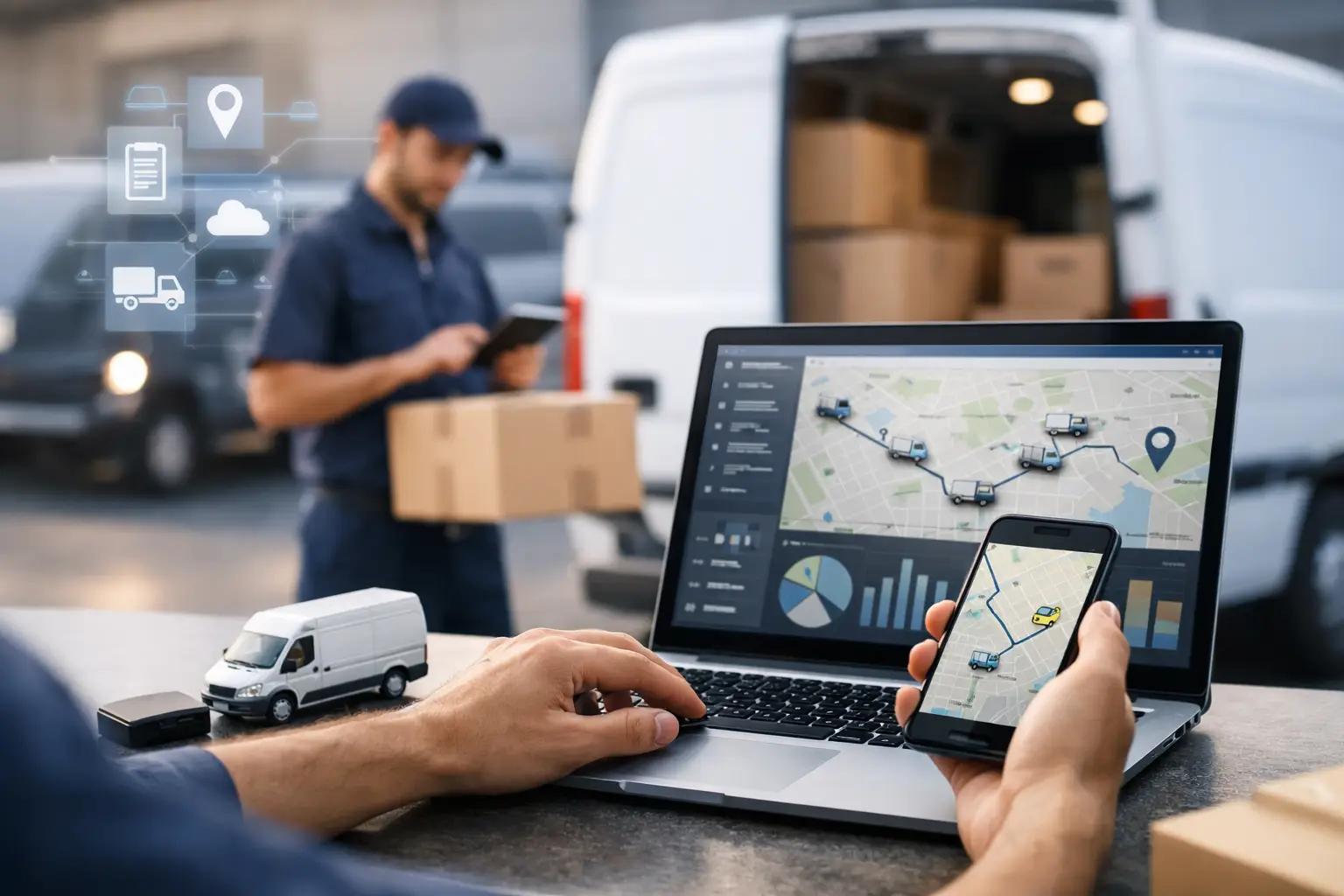
This is the most visible layer. The real-time status of vehicles, couriers, or shipments is monitored on a single panel. However, what is important here is not just the location information, but the accuracy of the status flow. Operational statuses such as "out for delivery," "not found at address," "delivered," and "in the return process" gain meaning in conjunction with location data.
Real-time tracking is particularly powerful in customer notifications, but it is not sufficient on its own. If data flows with delays or the field team doesn't regularly update status updates, the system appears live but is practically incomplete.
Every shipment has a lifecycle: Order received, prepared, dispatched, arrived at transfer center, out for distribution, delivered. A healthy tracking system standardizes this flow. This ensures different teams speak the same language and reduces operational uncertainty.
Strong status management directly improves reporting, as a report is only as healthy as its data structure. If statuses are irregular, performance analysis will also be flawed.
The field team doesn't work at a desk. Therefore, functions such as proof of delivery, signature, photo, note addition, selection of reasons for non-delivery, and route view need to work quickly on mobile devices. If usability becomes difficult, the team will start working outside the system, leading to data loss.
Having to speak to the call center every time increases operational costs. Structures like automated SMS, in-app notifications, or status screens provide transparency on the customer side. This not only creates satisfaction but also reduces the support burden.
The tracking system should also facilitate historical data review. Metrics such as delivery time, failed delivery rate, regional density, performance per vehicle, courier efficiency, and time-based operational analysis improve management quality. Investment decisions are also made more accurately based on these reports.
Every business has a different operational structure. An e-commerce brand, a business managing a local distribution network, a multi-branch cargo structure, or a corporate logistics operation do not have the same list of needs. Therefore, system selection should be based on scenario compatibility rather than feature comparison.
The first thing to consider is operational volume. Your daily shipment count, the number of active vehicles and personnel, the structure of the region you serve, and your delivery model determine the system. For a low-volume business, a cumbersome structure may create unnecessary costs. In a high-volume operation, simple solutions will quickly become insufficient.
The second critical point is integration. If order management, ERP, e-commerce infrastructure, call center, CRM, and accounting systems are disconnected from each other, the tracking screen alone will produce limited benefits. Every area where data is manually transferred creates a risk of error. Therefore, API compatibility and data flow are crucial.The ability of the system to function bi-directionally is a serious selection criterion.
The third issue is scalability. Businesses often make decisions based on current needs, but they may reach a different operational level after 6 months. The infrastructure needs to adapt when adding new cities, managing more vehicles, switching to a different delivery model, or integrating outsourced teams into the system.
Fourthly, user experience should be evaluated. The admin panel may be powerful, but if field personnel cannot use it, the system will not work in the field. Similarly, if the reporting screens are complex, managers will again resort to manual files to make decisions. A good system is one that is technically robust, as well as user-friendly and fast.
When businesses switch to a new tracking infrastructure, they often consider the technology sufficient. However, the problem is not just software selection. Expected results cannot be achieved without process design, team training, and established data standards.
The most frequent mistake is transferring old operational habits directly to the new system. If delivery statuses are unclear, task assignments are not precise, and exception management is not defined, the software will only transfer this complexity to the digital realm. Digitalization makes existing disorganization visible, but it doesn't solve it alone.
Another mistake is focusing solely on customer visibility. While it's valuable for a customer to be able to track their shipment, overall efficiency won't improve if the internal operations team can't identify bottlenecks. External experience and internal operations must be integrated within the same system logic.
Price-focused decisions are also risky in the long run. Lower license costs may seem advantageous initially, but lack of integration, insufficient reporting, or weak support processes can lead to higher operating costs. The total cost of ownership must be considered.
For medium-sized businesses with local distribution, speed and field visibility are paramount. In these structures, live courier tracking, proof of delivery, and route management yield quick results. In multi-branch cargo organizations, transfer points, internal distribution flow, and inter-center visibility become more critical.
E-commerce-focused brands benefit more from customer notifications and order integration, as tracking is also part of customer communication. In corporate logistics structures, SLA tracking, detailed reporting, authorization levels, and inter-system integration are more crucial.
Therefore, there is no single right model. The right model is established where the business's delivery promise intersects with its operational capacity.
The success of a tracking system is understood not by feeling, but by indicators. Shorter delivery times, reduced call center demand, decreased failure rates, increased route efficiency, and improved task completion speed by the field team are the clearest measurements.
In addition, managerial impact is also important. Team leaders see earlier what they need to intervene in during the day. Operations managers create a more effective capacity plan. Senior management can compare delivery performance in real-time and retrospectively. This visibility significantly reduces loss of control during growth periods.
Technology infrastructures focused on courier, cargo, and logistics, such as Sentigo, provide the advantage of managing the entire operation digitally, not just tracking. The real value lies in being able to unify fragmented processes under a single operational umbrella.
Businesses that treat cargo tracking not as a customer display but as a management system scale faster. Because a well-established tracking structure not only shows where you are, but also reveals where you are failing. When the right system is chosen, the delivery process becomes more visible, more measurable, and more manageable. This is a significant advantage for any business that wants to maintain control while growing its operations.
This content has been prepared by the Sentigo Editorial Board.