 English
 Turkish
 05 MAYIS 2026


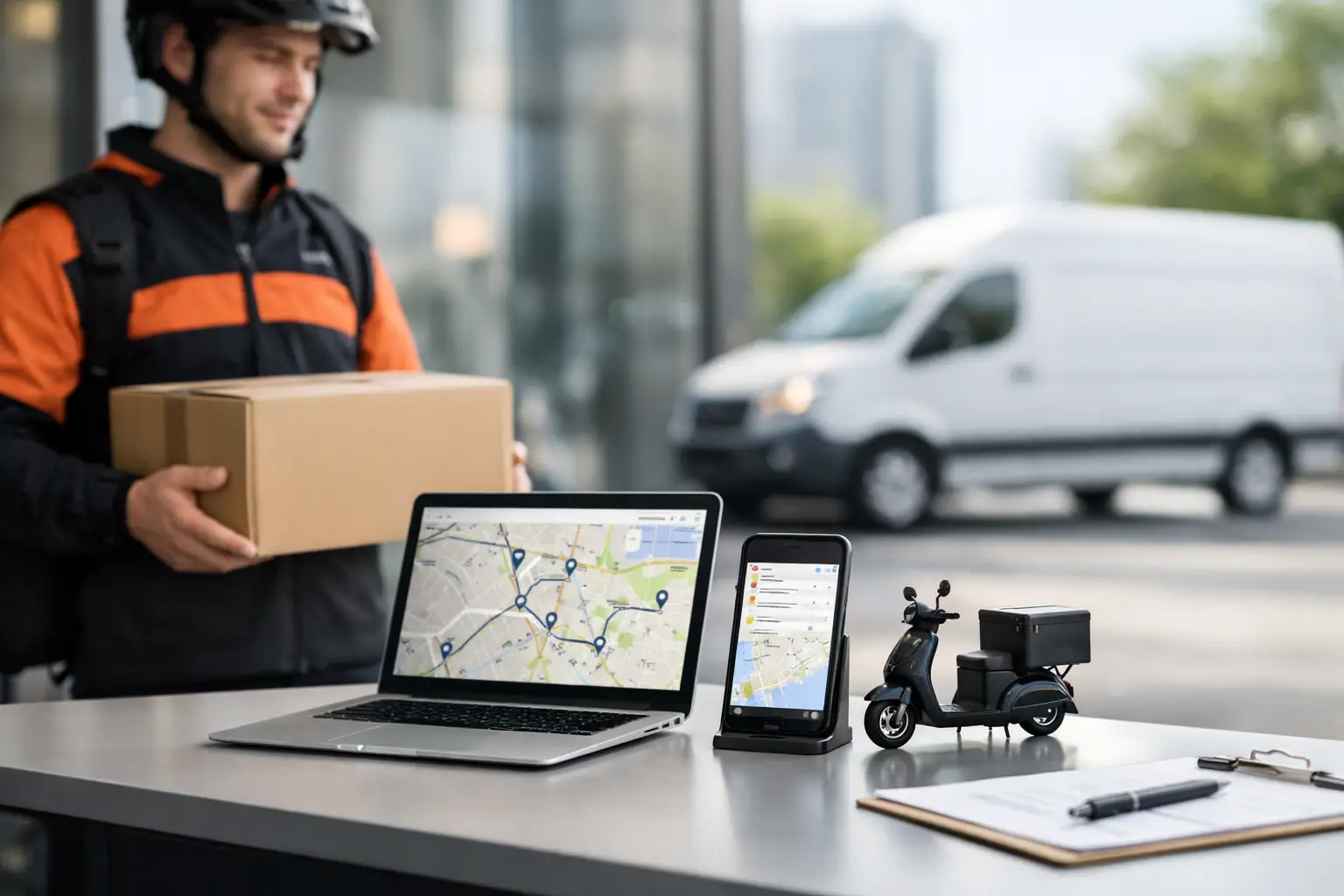
Delays in courier operations often don't begin in the field. The problem arises between the moment the order is placed and the moment the assignment is made. Therefore, when comparing courier software, simply looking at the mobile application screen or map view is insufficient. The real difference lies in how well the entire flow, from order acceptance and route optimization to live tracking, reporting, and integration, can be managed.
Many businesses first consider price when choosing software. However, as operations grow, the real cost becomes the manual workload, delivery errors, customer dissatisfaction, and unmanageable field performance created by a poorly chosen system. There are significant differences between systems used for same-day delivery, grocery delivery, restaurant distribution, e-commerce logistics, or corporate field distribution. A proper evaluation starts with operational compatibility, not the number of screens.
Courier software is no longer just a delivery assignment tool. For businesses, this system functions as an operations center. Order placement, routing to the appropriate courier, tracking delivery times, managing failed deliveries, and measuring performance must all proceed within a single structure. If one link in this chain is weak, the entire delivery experience is affected.
This is the fundamental reason why the benchmarking process is critical. While some solutions suffice for small teams, others become meaningful in high-volume, multi-location operations. For example, manual intervention might be tolerable for a business making 50 deliveries a day. However, in a structure that handles 2,000 deliveries a day, automated assignment, workload management, and integration capabilities become necessities, not just preferences.
The most common mistake when choosing courier software is mistaking flashy features for the primary criteria. However, the real question for decision-makers should be: Does this system make operations more visible, faster, and more measurable?
The heart of courier management is assignment. Does the system assign the order to the nearest courier, direct it to the most suitable capacity, or leave it to the operator's manual decision? This difference directly impacts delivery time. A good system should be able to consider real-time congestion, regional distribution, courier availability, and delivery priorities all together.
A similar distinction exists in route planning. Some software only provides directions on a map. More advanced solutions offer multi-stop optimization, time window management, and batch task scheduling. This difference creates significant cost advantages, especially for businesses using fleets or making multiple deliveries with the same vehicle.
Live tracking is now a standard expectation. However, not all live tracking produces the same value. Simply seeing the courier's location on the admin panel isn't enough. What's important is identifying the risk of delays early, analyzing delivery deviations, and providing transparent information to the customer.
This is where a robust panel structure comes in handy. Systems that provide real-time tracking based on region, courier, delivery type, and time make it easier for the operations manager to manage the field. Without this visibility, the team will only notice problems when a customer complaint arises.
If the courier application is poorly designed, even the best central control panel won't translate into results in the field. Courier task acceptance, navigation usage, delivery proof generation, status updates, and access to customer notes must be fast. Complex screens waste time in the field and increase data entry errors.
The key here is not just that the mobile application works, but that it runs smoothly under heavy operation. Performance at low internet quality, battery consumption, offline scenarios, and notification flow must be tested.
Courier operations don't work in isolation. Software that can't exchange data with e-commerce infrastructure, ERP, call centers, POS systems, marketplace systems, or customer service tools will quickly create a new manual burden. Therefore, integration capability is often more valuable than a feature list.
Systems with strong API infrastructure automate order flows, transfer delivery statuses to other systems, and reduce human intervention. This increases data consistency and maintains operational speed. This structure provides long-term sustainability, especially for growing businesses.
Another critical issue is flexibility. Standard integrations are useful, but not every business's processes are exactly the same. The ability of software to adapt to specific workflows makes adding new channels easier. This is precisely where infrastructure-focused solution providers like Sentigo excel: building structures that can expand in parallel with growth.
Courier software can run an operation. But good courier software improves the operation. Reporting is at the heart of this distinction.
Decision-making teams need to see not only how many deliveries were made, but also which areas experienced delays, which courier groups had increasing rates of failed deliveries, and which time periods experienced capacity issues. Without this data, improvement efforts are based on guesswork.
When making comparisons, the following questions are important: Does the system provide metrics such as delivery time, failed attempts, customer waiting time, courier efficiency, and regional congestion? Can these reports be filtered? Are they clear enough for operational decision-making? If the answer is no, the software manages delivery but doesn't improve performance.
Not every courier software is suitable for every business. For small-scale, local deployments, quick setup and basic tracking features may be prioritized. For these types of businesses, complex structures can sometimes become a burden rather than an advantage.
The picture changes for medium and large-scale operations. Multi-branch management, different delivery scenarios, role-based authorization, customer information flows, and centralized reporting become crucial. For corporate structures, security, data access control, and process standardization also become critical.
If a business aims for growth, it's more appropriate to choose software based on a 12-24 month operational plan rather than just current needs. Software changes are one of the most expensive transformations in an operation.
Software evaluation should not be done through a presentation screen. Testing with a real order flow is necessary. How is the order entered into the system, how long does it take to complete the assignment, how well is the courier service understood in the field, how is proof of delivery obtained, how are failed deliveries managed? These should be seen in a live scenario.
Furthermore, the support model should also be questioned. Is post-installation team training provided, is the SLA structure clear, are problem resolution times defined, and what is the approach for requested improvements? Software is not just a purchased product, it's a daily component of the operation. Therefore, the provider's approach directly impacts the business outcome.
A seemingly inexpensive system can create high operating costs. The need for manual assignment, poor reporting, inadequate integration, or a poor user experience create losses that aren't immediately apparent. On the other hand, a very comprehensive solution can exceed the actual needs of the business.
The right approach is to look at the total value. Does the software reduce delivery time, improve customer communication, reduce the workload of the operations team, and generate clearer decision data for management? The answers to these questions are more strategic than the license fee.
When comparing courier software, instead of looking for a single "best system," it's necessary to determine the system that best suits your operational model. Because as the field structure, delivery volume, integration needs, and growth plan change, so does the definition of "right software." A good choice is a system that can carry not only today but also tomorrow.
In the final decision-making stage, look at the workflow, not just the screen. Because what makes the difference in delivery operations is not what the software promises, but how many problems it solves unnoticed every day.
This content has been prepared by the Sentigo Editorial Board.