 English
 Turkish
 05 MAYIS 2026


There is a significant operational difference between a vehicle visiting 18 locations in a single day and the same vehicle visiting 18 locations sequentially. This difference is often not just a few kilometers. Fuel costs, delivery time deviations, customer satisfaction, courier performance, and fleet capacity are directly affected. Therefore, the question of how to optimize routes should be a fundamental agenda item not only for logistics teams but for every business managing delivery operations.
Route optimization is a broader concept than simply finding the shortest route. In real-world operations, the goal isn't just to reduce mileage. It also requires meeting delivery timeframes, not exceeding vehicle capacity, managing driver working hours, accounting for traffic congestion, and maintaining a positive customer experience.
Therefore, a good route plan visibly improves the performance of field operations. This means fewer empty kilometers, lower fuel consumption, more daily deliveries, and more predictable operations. For cargo, courier, retail distribution, and field service teams, especially those with multi-stop deliveries, this is directly related to profitability.
Manual planning, however, only works up to a certain scale. With 5-10 deliveries a day, an experienced operations manager can find practical solutions. But as the number of delivery points increases, same-day delivery requests become more frequent, and customer expectations tighten into tight timeframes, manual planning becomes insufficient. This is where data-driven route optimization comes into play.
A healthy optimization process begins with accurate data. Even the best algorithm will produce poor results if you have incomplete or incorrect address data. Therefore, the accuracy of delivery points' addresses, location data, delivery priority, time window, and order volume must first be clarified.
The second step is to define operational constraints. How many vehicles are there, what is the vehicles' carrying capacity, how long are the drivers' shifts, are there time-based entry restrictions in certain areas, and which orders need to be delivered quickly? Route optimization works by considering these variables together. Looking at distance alone often leads to incorrect decisions.
The third step is setting the goal. Every business has different optimization priorities. For some companies, reducing total mileage is the main goal. For others, increasing the on-time delivery rate is more critical. In some operations, making more deliveries with the same vehicle takes priority. The correct route plan should be designed according to this priority order.
The next stage is establishing the planning model. Here, delivery points are distributed to vehicles, the stop order is determined, and estimated arrival times are calculated. If the operation is live, the plan should not remain static. Traffic, cancelled orders, newly added tasks, or field delays can reshape the plan throughout the day.
Therefore, for modern businesses, route optimization is not a one-time plan but a dynamic process that is constantly updated.
One of the most common problems encountered in the field is that address data is not suitable for operational use. Missing door numbers, incorrect neighborhoods, free-text addresses that don't match on a map, or duplicate delivery records reduce the quality of planning. These types of data problems are a problem of the data entry process, not the algorithm itself.
Furthermore, not only the address but also the operational nature of orders is important. For example, a package to be delivered in 10 minutes cannot be planned with the same time assumption as a delivery requiring identity verification. Similarly, areas with high apartment density and industrial zones do not exhibit the same field behavior. Therefore, service time data also needs to be defined in the system.
As data quality improves, the optimization output becomes more reliable. At this point, integration infrastructure becomes crucial. If order management, warehouse system, courier application, and customer information flow are disconnected, breakdowns will occur in the field, no matter how well the route is planned.
A good route plan isn't based on a single variable. Distance is important, but it's not sufficient on its own. Traffic density, delivery time commitment, vehicle capacity, product type, regional density, and courier working hours must all be considered together.
For example, the shortest route isn't always the fastest. Especially in cities like Istanbul, where traffic patterns change drastically throughout the day, a plan that seems right in the morning might become inefficient in the afternoon. Similarly, assigning all deliveries in the same area to a single vehicle might seem logical at first glance, but it can reduce end-of-day performance due to vehicle capacity or service time per stop.
The critical issue here is finding a balance. An overly congested route creates delays in the field. An overly loose route leads to capacity loss. Successful optimization aligns theory with operational reality.
Manual route planning relies on experience. Experience is valuable, but it's prone to error when scaled up. The human eye cannot accurately compare dozens of variables simultaneously. Decision support systems become essential, especially in structures with hundreds of deliveries, dozens of vehicles, and different time windows.
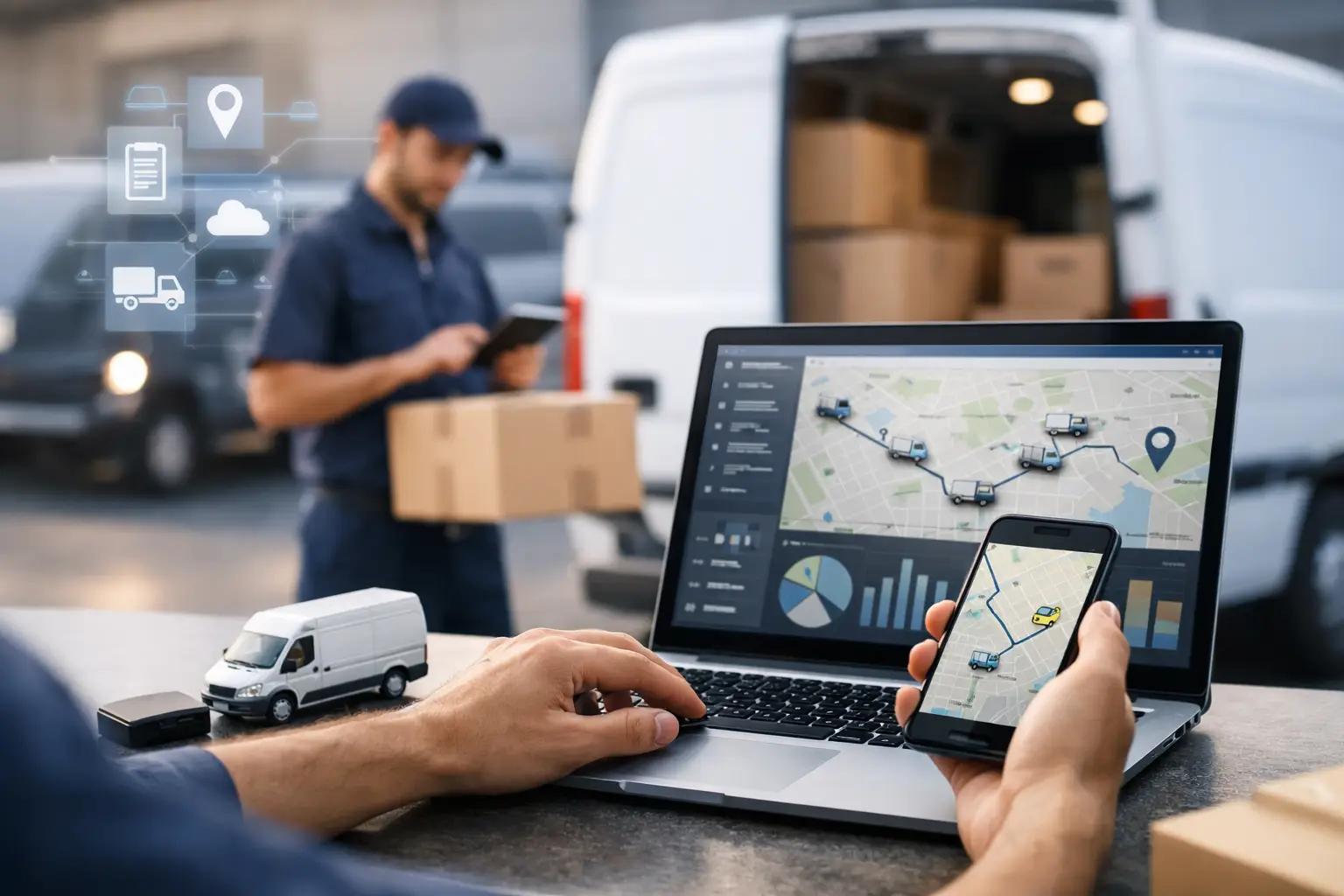
Software-based optimization performs calculations faster on large datasets. It systematically generates information on which vehicle should take which order, the most efficient order of delivery, and estimated delivery times. Furthermore, live tracking allows for comparison of plans and actual operations, enabling not only planning but also monitoring and continuous improvement.
There's an important point here: software does not replace operational knowledge. The best results are achieved when field experience and technology work together. The operations team defines the rules correctly, and the system applies these rules in a scalable manner.
To understand whether optimization is working, results need to be measured. Simply creating a plan is not enough. Total mileage, number of deliveries per vehicle, on-time delivery rate, cost per delivery, and idle mileage rate must be monitored regularly.
In addition, the difference between the planned arrival time and the actual arrival time is also important. If deviations occur in the field despite the system consistently generating good routes, the problem usually lies in operational discipline, data quality, or a lack of live intervention.
Some companies focus solely on fuel savings. However, overly aggressive savings targets can negatively impact the customer experience. When delivery delays increase, call center load and customer dissatisfaction costs also rise. Therefore, the metric set should be balanced.
The needs of courier, cargo, e-commerce distribution, field service, and heavy transport operations are not the same. In a fast-delivery courier operation, real-time rescheduling may be more critical. In cargo distribution, regional density and vehicle occupancy rates are key factors. In cold chain or sensitive product transportation, transportation conditions, as well as time, influence route decisions.
Therefore, there is no single model that suits everyone. The business's delivery type, order volume, city structure, and service level target must be evaluated together. The technology infrastructure must also be flexible accordingly. Operation-oriented software infrastructures like Sentigo create real value by considering route planning not just as a route drawn on a map, but also integrating it with tracking, task management, mobile usage, and integration.
A significant number of companies view route optimization as simply purchasing software. However, software is only one component of the process. Systems purchased without address standardization, defined delivery rules, and adaptation of field teams to the new operation will not provide the expected efficiency.
Another mistake is not updating the plan at all during the day. Operations are dynamic. New orders come in, customers are not present, traffic increases unexpectedly, and vehicles break down. Dynamic field management cannot be achieved with a static plan. Therefore, live monitoring and reassignment capabilities are critically important.
Furthermore, focusing only on short-term gains is limiting. Initially, a few kilometers of savings may be seen, but the real value emerges with the accumulation of operational data over time. Questions such as which areas experience delays, which time intervals have insufficient capacity, and which vehicle type operates more efficiently on which route can only be answered through regular data analysis.
It's not necessary to transform the entire operation at once. It's healthier to conduct a pilot study first on a specific region, vehicle group, or delivery type. This approach makes existing bottlenecks visible and allows teams to transition to the new system more cautiously.
Data cleaning, rule definition, live monitoring, and performance reporting should be addressed together during the pilot phase. As initial results become available, the model is refined, then scaled up to a wider operational area. Scaling decisions should be based on performance data, not predictions.
When route optimization is properly implemented, it improves not only delivery time but also the overall quality of operation management. This is where the real benefit for decision-makers begins. Because a visible, measurable, and controllable operation makes growth more controlled and profitable.
This content has been prepared by the Sentigo Editorial Board.