 English
 Turkish
 05 MAYIS 2026



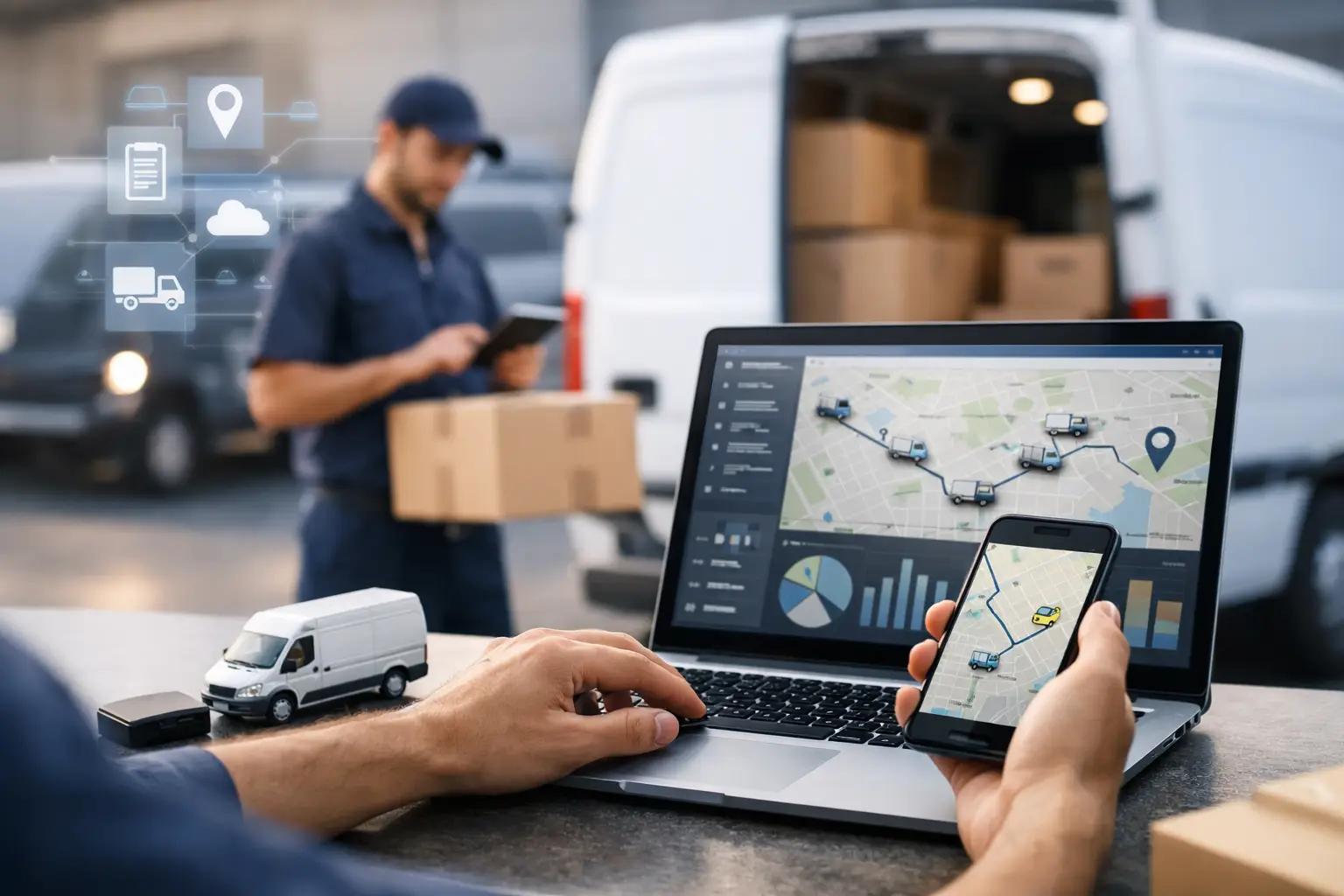
Knowing where a vehicle is isn't enough on its own. The real challenge is being able to see on the same screen why that vehicle is delayed, whether the delivery is profitable, which route is increasing costs, and where the operation is stalled. Transportation management software addresses precisely this need: it makes transportation operations not only traceable but also manageable.
Growth in logistics, transportation, courier, and distribution processes often means more vehicles, more personnel, and more orders. However, growth without software support also brings a loss of control. Excel spreadsheets, phone traffic, disorganized WhatsApp communication, and manual planning eventually slow down operations. Therefore, the real question for decision-makers isn't: Is software necessary? The real question is: What level of visibility, automation, and integration is needed?
Transportation management software is a digital infrastructure that enables a business to plan and track its shipment, route, vehicle, driver, delivery, and customer information processes from a single center. Its primary goal is to reduce operational complexity while providing speed, accuracy, and cost control.
These software programs are not just vehicle tracking systems. A well-designed system collects order flow, assigns tasks, optimizes routes, updates delivery statuses in real time, manages customer communication, and generates reports for management. This reduces the information gap between the field and the central office.
This difference directly impacts profitability, especially in companies with multi-stop deliveries, e-commerce-supported distribution operations, urban courier networks, and planned transportation organizations. Even small delays in transportation operations can generate significant costs in high-volume operations.
Many problems in operations are not technically apparent; they are process-related. An order is received correctly but assigned to the wrong vehicle. The correct vehicle is selected, but the route is inefficient. Delivery is made, but proof is missing. The customer is contacted, but the correct information is not provided. Ultimately, the problem is not at a single point, but throughout the entire flow.
Transportation management software unifies this fragmented structure. The planning center, field team, customer service, and management work together on the same data. This provides a significant advantage, especially in operations requiring quick decision-making.
The most frequently resolved issues are generally similar. Time loss due to manual task assignment is reduced. Route errors and unnecessary mileage are reduced. Driver performance becomes measurable. Proof of delivery is standardized. Customer notifications function regularly. Most importantly, operations become system-dependent, not individual-dependent.
In logistics, efficiency is often sought in the wrong place. New vehicle investment, additional personnel, or a more intensive field organization alone do not provide a solution. If planning and monitoring are weak, efficiency may not increase even with increased capacity.
Software provides a fundamental control layer here. Questions such as how full each vehicle is, which regions are experiencing increased delivery traffic, at what times delays occur, and which customer groups have higher return rates can only be answered with regular data. Without data, management relies on experience. Experience is valuable, but it becomes insufficient as scale increases.
Therefore, transportation management software is not just a technology investment, but a management tool that improves decision quality. This effect is even more evident in structures with multiple warehouses, distribution points, or field teams.
Not all software addresses the same needs. Therefore, when making a selection, it is necessary to look not only at the feature list but also at the practical application of these features in the field.
Route planning is one of the areas that most directly affects transportation costs. The shortest route is not always the most accurate route. Traffic density, delivery time window, vehicle capacity, regional constraints, and priority shipments must be considered together.
Good software takes these variables into account. Thus, planning improves not only in terms of speed but also in terms of resource utilization. Especially in businesses that offer same-day delivery and multi-point distribution, route optimization produces tangible results in a short time.
Monitoring field operations from the center is now a fundamental expectation. However, live tracking should not be limited to showing location. Vehicle status, task progress, delivery stage, and exception notifications should also be visible.
This visibility strengthens customer communication, reduces unnecessary phone traffic for internal teams, and allows for faster intervention in crisis situations. Especially in delivery delays, early detection is always more valuable than late disclosure.
Mobile usage is critical for the field team to feed the system in real time. Drivers or couriers should be able to update delivery status, add proof of delivery, make notes, and instantly assign new tasks.It should also be visible.
Without a mobile application, data flow between the central office and the field is delayed. This weakens the accuracy of reports and operational responsiveness. Therefore, a user-friendly mobile experience is not a technical requirement, but a direct operational necessity.
When transportation management software operates independently, it provides certain benefits. Its real value emerges when integrated with ERP, e-commerce infrastructure, call centers, accounting, warehouse management, or CRM systems.
Integration eliminates the need for data re-entry, reduces error rates, and speeds up processes. However, there is an important detail here: every business has a different existing system structure. Therefore, a flexible and robust API infrastructure is a critical selection criterion for long-term use.
No. The choice of transportation management software varies depending on the sector, volume, delivery model, and operational structure. A local distribution business managing 50 shipments daily does not need the same level of in-depth solution as a corporate structure handling multi-city shipments.
Small and medium-sized enterprises generally benefit more from systems that are quickly deployed, easy to use, and provide real-time visibility. Larger organizations tend to focus more on areas such as authorization, multi-operation configurations, advanced reporting, and integration capabilities.
The critical point here is to avoid choosing an overly complex system that reduces utilization rates. On the other hand, choosing based solely on current needs is also risky. The ideal solution is one that manages the existing operation without straining it and has the flexibility to handle growth.
Evaluating the value of transportation management software solely based on license costs is incomplete. The real measurement should be done through operational gains.
For example, reduced fuel consumption through route improvements, shorter task assignment times, a decrease in failed delivery rates, a decline in customer support requests, and increased field team productivity are directly measurable results. In addition, there is another area that is more difficult to detect but effective: managerial control.
When managers begin monitoring operations with data, the speed of decision-making increases. Problems are evaluated not with personal opinions, but with system records. This creates a stronger structure in both internal team management and customer relations.
The implementation process is just as important as the software selection. Even the best system won't deliver the expected results if the configuration is flawed. The first step is clearly mapping the existing operation. Where is the order created, how are tasks assigned, how is delivery verified, how are exceptions managed – software installation is incomplete without clarifying these flows.
The second critical aspect is user adaptation. Field teams and the operations center need to easily adopt the system. Therefore, interface simplicity, training time, and support quality directly impact success.
The third area is reporting. Each business may have a different set of KPIs to track. Some focus on delivery time, some on cost, some on customer satisfaction. The software's ability to provide these reports flexibly makes a significant difference.
This is where logistics-focused infrastructure providers like Sentigo stand out: offering solutions that understand the real pressure points of the operation, correctly design the data flow between the field and the center, and transform this into a scalable structure.
Today, competition in transportation operations isn't won simply by making more deliveries. Businesses that build a more visible, measurable, and controlled structure gain an advantage. The right transportation management software is one of the most practical ways to establish this structure. If operations are growing but visibility isn't increasing at the same rate, the first thing that often needs changing isn't the number of vehicles, but the infrastructure managing the system.
This content has been prepared by the Sentigo Editorial Board.